Showing posts with label Western Screech Owl. Show all posts

Saturday, May 27, 2017

OWLS and OWLETS!

Today Ken and I checked the boxes on the Reserve. We were particularly interested in Nest Box #15 (sort of like an address) where we discovered a nesting Western Screech Owl, 37 days ago in April. Today May 27, we saw a mom owl with her two owlets and a nice meal for the chicks, a deer mouse (peromyscus sp.)

A view from above: 3 screech owls and breakfast. Note the larger owlet on the left.
Owl eggs hatch asynchronously, so one will be a little older than the next.
Ken removed the female and lowered her down to me for banding. She remained still and calm through the process.We returned her to the box after taking some measurements and examining her condition.
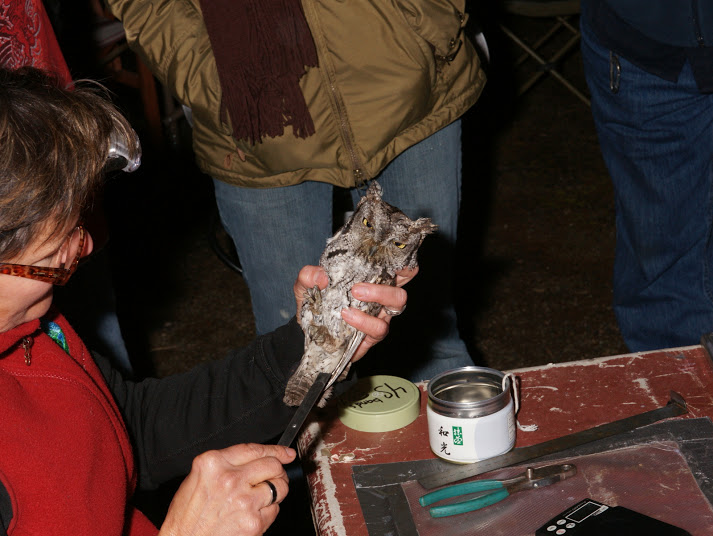
Here I am taking the wing chord measurement of the owl.
Note the band on her right leg.

Then I looked at her brood patch. Hormones help release breast feathers providing direct heat exchange for incubating eggs and brooding young,until owlets can thermoregulate on their own. This female's brood patch is already getting pin feathers (two dark lines under her bare skin), because the owlet's feathers now keep them warm. By fall her breast will be feathered, which will help keep her warm for the winter months.

The brood patch, well past its use for warming chicks. Because the
chicks now have feathers they no longer need warming by the adult.
Leftover prey shows the male is a good provider. He was likely roosting in a cavity nearby, and maybe observing us. Stay tuned for the rest of the story!
A view with the mom removed. The owlets are about the size
of an adult deer mouse (right corner), and too small to band.
The Cornell Lab of ornithology is a great resource for bird natural history including screech owls. Also click here for a nice overview of owl courtship and reproductive behavior.

Friday, April 21, 2017

OWL IN THE NEST BOX!

Western Screech Owl inside a nest box
Can you see the the owl in the box?  You are looking at the head and back of a Western Screech Owl inside nest box # 15. We believe she is incubating eggs due to her flattened posture and absolute stillness when we peeked the camera into the box. If she is incubating and all goes well, we can expect to see 2-7 nestlings within the next month.

So how did we see her? This winter Ken and crew installed nest boxes to determine potential use of the BCCER as breeding site for Northern Saw-whet owls, a cavity nesting species. To check the nests Ken attached a flexible cable with tiny camera and LED light to a bamboo pole, plugged in to his tablet. He can feed the camera quietly into the cavity entrance, see what is inside on his screen and then take a photo. We have conducted two box checks,

Ken's nest-cam set up. The camera is at the end of the pole
inside box #4. He is viewing the inside of the box on his tablet.

one on March 11 and one on April 19. In March, we found bird feces in two two boxes but no birds were present. We guessed the boxes were used by Northern Flickers roosting in the boxes at night. In April, we found identifying flicker feathers in the same boxes, and then we found the screech owl in a third box, What a fun surprise! Learn more about Western Screech Owls here.

Thursday, February 16, 2017

BAT-EATING WESTERN SCREECH OWL?

We know based on aural and/or visual detections that we have at least five species of owls on the Reserve; great horned owl, Northern pygmy owl, Northern saw-whet owl (NSWO, fall through spring?), California spotted owl (winter only), and Western screech owl (WESO). The screech owls are year-round residents and will sometimes come to investigate our NSWO caller, so they get caught in the nets. We have banded 25 WESO over 12 years of monitoring NSWO. Sometimes we are lucky to see them roosting in a cavity during the day, or perching at night. Banders Erika and Ken saw this owl perching in the barn, likely
Western screech owl in the barn at the Reserve
Possibly foraging on bats? He/she appears a little
perturbed at the disruption!
taking advantage of barn mammals. It may have been foraging on the bats that roost there! There happens to be a colony of wintering free-tailed bats, and potentially other bat species, living in the barn. I have seen great horned owls, peregrines, merlins, kestrels and red-tailed hawks capturing bats as they exit their roosts. It was quite an exciting flight dynamic as the predator bursts in a cloud of bats.  The success rate on capturing bats seemed pretty low. What we need to determine if this WESO has a palate for bats, is to find some pellets to identify prey remains.

Saturday, September 26, 2015

OWLING OUTING #1 FALL 2015 - starts with a SCREECH!


Our first night was early for the season but we wanted to see if there were any saw-whet owls in the area.  In fact the night was full of owl sound, Great horned hooting screech owls trilling and a toot-toot-toot from a saw-whet!  So at least there is one on the Reserve.
First night's team!! Veteran owl banders Tyler, Raina,
Sheila, Ken (back), and Steve.  Western Screech Owl
the star of the night-held by Raina
Ken and Tyler even heard a common poorwill, a migrant night jar that breeds on gravels and rocks on ridges in our local mountains.  More about them later. Below is a western screech owl, banded and released. A good first night!
Western screech owl, resident of the Reserve

Saturday, January 18, 2014

OUR DINNERS WITH HOWARD

Words cannot express the sadness in saying goodbye to another friend, so generous to our cause and an intelligent, witty and kind soul. Our memories are happy when we think of Howard Wurlitzer (yes, of Wurlitzer pianos and jukeboxes!), his mischievous laugh and smile and LOVE of field biologists, their stories and research. I had the great opportunity to meet Howard in 2009 at our owl banding site at BCCER during a Candles in the Canyon reserve fundraiser.  After meeting his first Saw-whet, we became fast friends and Howard became a big supporter of  Altacal's NSWO migration project.
Howard's first NSWO-she got him hooked! Saw-whets do
that to people.
To show our appreciation, our crew of banders (which often varied from year to year) set up an annual NSWO banding dinner at Howard's house in N. Chico. Each year's group of banders came with nets, poles and banding equipment and set up a few nets on Pine Creek that ran past Howard's home. We brought pasta or chili, salads and breads, and bottles of wine and engaged in a yummy feast around Howard's big table. In year two, we were joined by Howard's son Lindsay and wife Paula,and our tradition continued through Dec. 2013. Most years we captured the resident Western Screech Owls, but in 2012 we captured our first Saw-whet, which confirmed that at least one was wintering in the oak woodland habitat that is dominant on the property.
Our first dinner with Howard. True we look quite civilized
and subdued but the fun and the tradition had just begun!

There are so many stories to share but one most memorable happened when we were all chatting at the table and Dorthy, Howard's good friend, said excitedly "there's a ringtail at the window!" And there at the porch slider was a ringtail  peering at us-as though it was asking for a handout.We truly had a National Geographic moment on that well-lit porch, when this normally elusive mammal climbed up an overhanging oak tree and picked off a sleeping songbird, plucked its' small meal, and then scampered away. What a sighting for us!

Howard had a knack for engaging you in a great story, usually biological but also about art, regional history, good wine and local legends. We are so honored to have met this man and called him our friend. We will miss you Howard!
Howard with one of his resident W. Screech Owls and three
friends, Julie, Dorothy and me.

Wednesday, October 23, 2013

NSWO - Halting to a SCREECH

Our owl of October 2013 is undoubtedly the Western Screech Owl, having so far, captured four of them and only two saw-whets.  Screech Owls are resident birds, breeding on the Reserve and living here year round.
  
Guest with 5-year old Western Screech Owl
They are likely curious about whooooo has come to their forest and are often incidentally caught in our nets when we are playing the saw-whet calls. We captured our first one last week, and then another 3 in one night! One female was a recapture who was originally banded in October, 2008.  Recaptures relay great stories, such as a birds' age, she being at least 5 years old.  Their memory also must be quite good, taking her a full five years to revisit her experience in the nets! Our grand total so far: 2 NSWO and 4 WESO. Where are the saw-whets?!

Sunday, March 17, 2013

Star Parties and Spring Sampling

Based on our random banding efforts, spring migration is variable and unpredictable as to timing and location of owls moving out of the area. Knowing that we might not detect owls is not much of an incentive to get out there!  But when there are curious people and a possibility of meeting an owl, it's a good excuse to give it a try.  This night my friend's niece, nephew and sister visiting from Texas wanted to see a saw-whet. They had supported our adopt-an-owl program, how could I say no? We set up at the Butte Creek Ecological Preserve station on March 14, 2013. Our 1.5 hours of effort produced no saw-whets, not even a toot. But, as fortune would have it, we captured a Western Screech Owl, potentially the mate of the screech owl we captured at the 2013 snow goose festival event.

The family meeting their first Western Screech Owl, just before release.
Note the excitement and smiles the little owl elicits! Photo by Carolyn Short.
Our next spring sampling event occurred during CSU Chico Reserve's spring naturalist outing "Owls and Astronomy" field trip with star-man David Samuels. We met David on March 16 2013,at the Big Chico Creek Ecological Reserve. He was equipped with 3 large scopes set up in the meadow near our OWL3 station. David educated and entertained us with his amazing knowledge of  planets, stars, nebulas, galaxies  constellations and other heavenly bodies. 

David Samuels weaving the myth surrounding the constellation Ursa Major
My favorite scope view was the Orion Nebula. In David's scope it did not have the color like the web picture below, but it was ethereal and lovely, clouds, space and stars. For star-gazing it was a wonderful evening!

Wikipedia photo of the Orion Nebula seen in the belt of the constellation Orion
Although no saw-whets were detected or captured, the combo trip was an ingenious way to introduce participants to night-time phenomena. The owl team gleaned more data for our spring migration sampling; no detections could mean owls have already moved on from their wintering grounds to their breeding grounds. 

Sunday, February 3, 2013

SNOW GOOSE FESTIVAL OWL CAPTURES AND THE MOON

Last post I questioned if owl captures could be related to moon phase.  Literature from back east where the majority of owls are says yes, they are.
Web photo, Northern Saw-whet Owl and the Moon
Theory has it that if the moon is bright, the small owls may not be as active because they may become prey instead of predator. Big owls, like the Great Horned will predate the Saw-whet. Where Barred Owls are present, netters have quite a challenge keeping them away from nets set during Saw-whet monitoring - the Barreds react to the Saw-whet call as though it were a dinner bell. Fortunately at our current sites we don't have to worry about Barred Owls-yet!

Another theory is that the owls can see the net array when the moon is bright. Indeed we can sometimes walk to the nets and not even need headlamps, so we figure if we can see the nets shimmering under moonlight, then certainly the nocturnal eye can.

Because our owl captures are relatively low (a small sample size) during the Snow Goose Festival, I graphed the outcome, owl captures vs. moon phase. Here's what that looks like (two of the data-points are missing the moon phase graphic-but you get the picture).  The graph shows the number of owls captured on the primary Y axis (left), the % moon phase on the secondary Y axis (right side) and the date of capture on the X axis. You can see during the brightest moon we do catch fewer Saw-whets, by one per/effort.  On our last night in 2013, we caught a Western Screech Owl at BCEP, and a Saw-whet at BCCER, so only one owl per site. Interestingly two of our three owl captures on full moon nights were Western Screech Owls. Using this small data set, we would have a higher likelihood of capturing any Saw-whets in the area during Snow Goose Festival on a no moon night. That makes sense with the given theories.

Thursday, January 31, 2013

Snow Goose Festival Owls!

Since 1999 we have conducted an Owl Monitoring and Banding field trip as a Snow Goose Festival event, occurring in late January.  It is a  perfect time to sample the area for wintering Saw-whets. This year we ran two different sites concurrently to see where the owls were.  My team, Steve, Jo, Sheila and Maureen, went to Butte Creek Ecological Preserve. Maureen and Steve took the group on an owl prowl to listen for Pygmy, Great Horned, Western Screech and Barn Owl.  Not a toot, hoot or screech was to be heard!  Meanwhile Jo, Sheila and I had set up nets for Saw-whets. While we waited, we heard a dueting pair of Great Horned owls across the creek. Steve brought the guests to our station and after lots of conversation and four empty net runs, a Western Screech Owl waited for us in the net. Our group was very happy!
Western Screech Owl: here I am measuring the owl's tail length to help determine its
gender- which I could not. The screech owls tend to be very calm during handling.
Steve King Photo

SGF group with Western Screech Owl, BCEP. Steve King Photo

Meanwhile up at the Big Chico Creek Ecological Reserve (BCCER), Mike, Raina,Nancy and Julie were running the OWL3 site, our typical fall migration station.  Their guests got a good listen to a dueting pair of Great Horned Owls, but there were no owls in the net.  As luck - or the odds of getting a Saw-whet during SGF-would sometimes have it - the team finally got one, on the last net run. Unfortunately all the guests had gone, with an invitation to return next fall during our busy season.  
A temporarily upside-down Northern Saw-whet Owl. The owl is laying
gently against the banders palm in the "bander's grip," a hold that safely
secures the bird. The bander is checking the molt on this bird. 

Here she is - a bird that was previously banded during migration in November 2012. Our guests enjoyed the evening, stories and facts and mysteries about owls. For us, any information adds to our knowledge of Saw-whets.  At BCEP no owls were detected - are they not wintering there this year? At BCCER at least one Saw-whet was wintering and has used the Reserve habitats for 2 months since she was captured. But the questions continue. Where did our 119 fall migrants captured during the fall go? Could our lack of detections be related to the moon phase? More on the moons influence and owl captures to come.........


Friday, January 21, 2011

Winter Sampling at the Dye Creek Preserve

On January 20, 2011, Julie Shaw and I met with Preserve Associate Jackson Shedd, at the Dye Creek Preserve in Tehama County. The Dye Creek Preserve is managed by The Nature Conservancy (TNC) and is almost 38,000 acres in area. Our ongoing study to understand winter roost selection of saw-whet owls in the area led us to sample the Preserve. The habitat is quite different than our current sampling locations near Chico. The majority of the site consists of Blue Oak woodland and grassland, however Dye Creek is lined with dense riparian vegetation, similar to the Butte Creek Ecological Preserve (see post A Winter Sampling...). The big difference is the lack of winter over-story vegetation from conifers and Live Oaks. Although Live Oaks are scattered in the uplands lining the creek, most of the vegetation is deciduous (the image below shows full leaf out- not winter). But, due to our telemetry study with Julie, we know NSWO select low dense shrubs and Live Oak trees to roost; both components of the Dye Creek Preserve habitats. We figured they just might be roosting along the creek. In these two images you can see the Dye Creek site (upper) and an expanded view of the three sampling sites, Dye Creek, BCCER (higher elevation), and BCEP (lower).


We set up for two hours under a clear sky dotted with stars. An almost full moon came up near the end of our monitoring session. During this time we never detected or captured a saw-whet owl. Based on my experience if NSWO are in the area they will likely respond. I interpret the nights lack of response to mean there were no saw-whet owls using the area during the sampling period. We will try again! We did have a night full of sound, coyotes singing, and many flocks of Tundra Swans and Snow Geese flying overhead. Plus, we captured a Western Screech Owl, released by Jackson Shedd (photo by Julie Shaw).