Saturday, October 13, 2012

OWL SEASON, 2012-OFF TO A FLYING START!

Our saw-whet season officially starts October 15 with our standardized 5 days/week monitoring. But we always like to do a little random sampling to see when the first birds show up.  And we are glad we did!

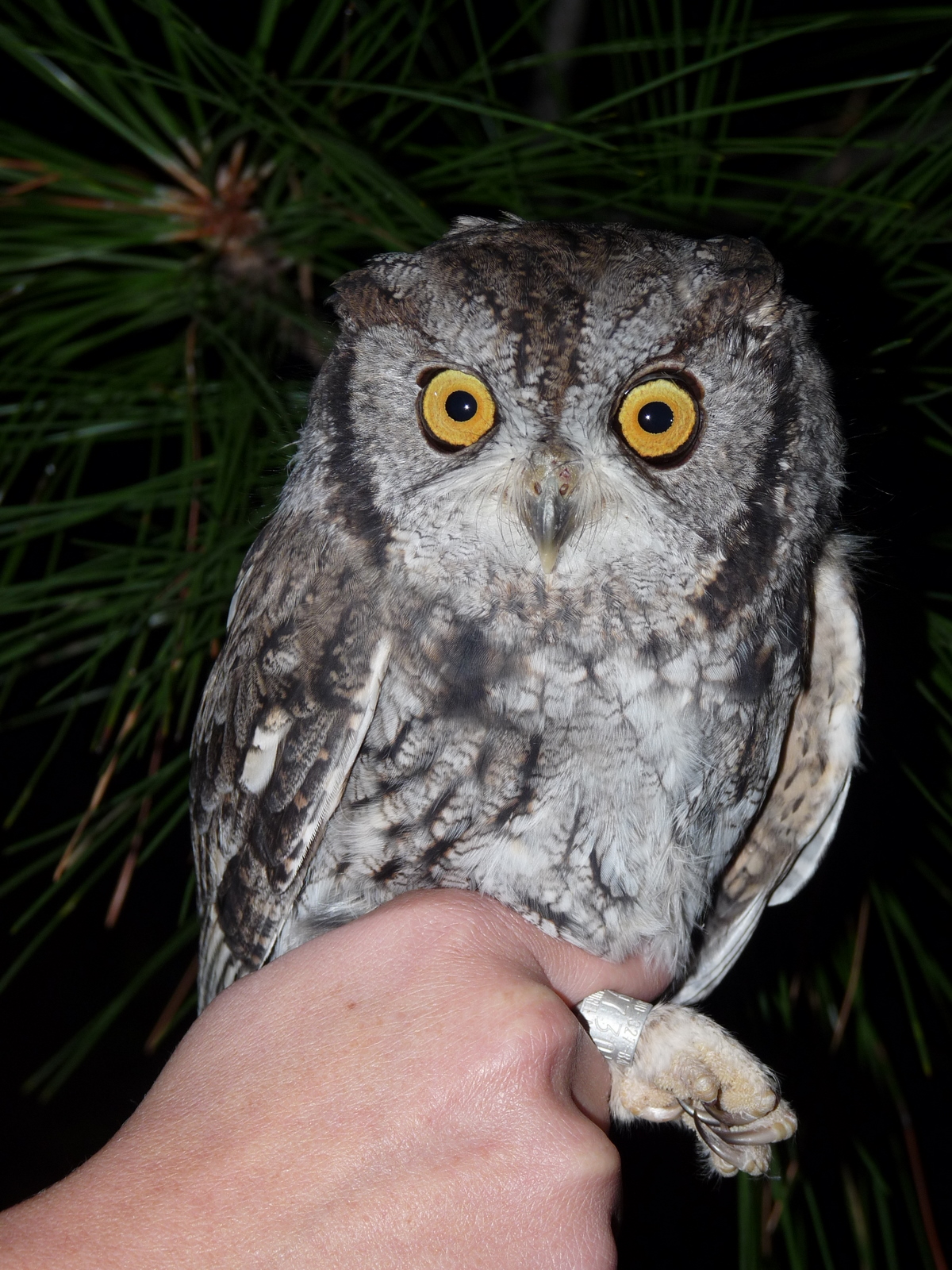
Trio of Saw-whets! Photo by Steve King
Starting on September 29th, we had a zero owl night, with no owls (of any species) heard. On October 6th banders Mike Fisher, Raina and Steve King and Julie Shaw gave a special outing to Big Chico Creek Ecological Reserve guests. Everyone was incredibly pleased with TWO saw-whet owls and a Myotis bat, hooting Great horned owls and a trilling screech owl.

Since then:
October 8: 2 NSWO, 1 Hatch year (HY), 1 After Hatch Year (AHY)
October 11: 6 NSWO, 3 HY and 3 AHY!

It is bound to be a good season for owls!
You can join us too - check out the post below for our awesome owl outing raffle.

Sunday, September 16, 2012

IT'S FOR THE OWLS! 2 INCREDIBLE FUNDRAISING EXCURSIONS

OWL Fans Unite! 
Fundraiser to Support Altacal's  Northern Saw-whet Owl Project!
Northern Saw-whet Owl nestling, photo by Marcel Holyoak
Two Unique Adventures at the Big Chico Creek Ecological Reserve 
**for 4 Lucky Winners and 4 lucky guests!**

1)     Northern Saw-whet Owl Mist Netting and Banding - a nocturnal excursion!
Saw-whet Owl release, photo by Steve King
Tune in to the forest night life under the Milky Way, listening to owls; hooting Great Horned, trilling Western Screech, and tooting Saw-whets, and the sounds of other nocturnal critters. You will learn about the migratory ecology of the Northern Saw-whet Owl (Aegolius acadicus) in the Sierra Nevada foothills with avian ecologist Dawn Garcia and her banding crew. Mist-netting and banding will be conducted at the Reserve where Dawn is researching owl migration, now in its 8th season.  Guests will observe owl banding and data collection, and may have the rare opportunity to release one of the petite owls!  It is an easy walk from the banding station to the nets. A specific date between October 30 and November 30, 2012 will be arranged with the raffle winners as the season approaches. 
OR
2) Tracking the Northern Saw-whet Owl - a diurnal excursion!
Enjoy beautiful fall foliage and avian species such as red-tailed hawks, California quail, wild turkey, sparrows, hermit and varied thrushes, American dippers, and possible western screech/northern pygmy owls while tracking radio-marked saw-whet owls. Bobcats, mule deer, and bears are often seen on the Reserve as well.  Tracking may include crossing Big Chico Creek and hiking up steep slopes. The terrain can be strenuous depending on where the owls are.  Be prepared for an adventure! A specific date between November through December 2012 will be arranged with raffle winners as the season approaches.

"Luna" Saw-whet Owl roosting, photo by Julie Shaw
How to Purchase Tickets!
Raffle tickets will sell for $3.00/ticket or 2 for $5.00 at our September 17 and October 15 programs at the Chico Creek Nature Center and events: The Oroville Salmon Festival  on September 22, 2012 and Sacramento Wildlife Refuge’s Birthday Bash on October 13, 2012. You can also email me at conservation@altacal.org.  We will draw names for four winners on October 27, 2012.  ** each winner can invite 1 guest for the excursion of their choice.**

Sunday, July 22, 2012

Flammulated Owl Night at Lake Davis

Mid-July I took fellow owl researcher Julie Shaw to check out a Flammulated Owl (Otus flammeolus) project that is occurring on the Plumas National Forest. I work on the Plumas, conducting Northern Goshawk and Spotted Owl surveys (and other species surveys), but not near Lake Davis. David Arsenault, founder of American Valley Environmental and Plumas Audubon Society (PAS) President, received funding from the US Forest Service (Beckworth) to conduct Flammulated Owl (FLOW) nesting surveys around Lake Davis where FLOW numbers are known to be high. He will examine FLOW populations in different FS management areas including fuel reduced and harvested stands. For more about this exciting and necessary project go here. David invited us to join him and his crew for an evening of FLOW banding. We were targeting the adults in one known nest. They found a nesting pair in a small woodpecker cavity (probably a white-headed woodpecker) in the large snag in the middle of this pic. This is what nesting FLOW habitat looks like.
Flammulated Owl habitat and nest cavity
You can also see the cavity here. David's crew is setting up mist nets proximate to the nest. They had watched the pair's flight path and knew that there were 3 eggs the cavity (2-4 is average).  They knew the birds would fly back and forth with moths, beetles and other insects - to feed the nestlings.
Setting nets in front of the nest snag
And we were successful!  Although the female bounced off the net and was too wise that night to be captured (she was captured and banded later). The male was captured 2x. See Julie taking out the male FLOW from the net.

Julie extracting male Flammulated Owl
Once extracted,  we weighed the male - a whopping 51 grams.  Our small male Saw-whets weigh 73 grams.  The one N. Pygmy Owl that I banded weighed 61 grams. These Flammulateds are tiny predators!  
Colin weighing FLOW - 51 grams, David taking data
Male FLOW - note the rusty/rufous color on the owl, giving the
species its ' name: flame or of a reddish color.
And I got to release my first-in-the-hand, Flammulated Owl!  We took down the nets and left the owls to their nocturnal foraging. Thanks David and crew, we look forward to hearing more of your study results.
Happy me!


Friday, February 10, 2012

Snow Goose Festival Outing 2012 - Owl Success!

Every season for the Snow Goose Festival we offer our Northern Saw-whet Owl banding and survey. It is always a sell out and this year was no different. The late January date (26) also allows us to see if we continue to have wintering saw-whets on the Reserve. We always start off with an owl prowl to survey the other species in the area. This year we had the resident pair of Great Horned Owls, putting on a nice vocal show of dueting.
As in most raptors the female is bigger than the male, but in the owls, the female has a higher pitched voice, making a nice auditory duet of high (female) and low (male) responses. I love this picture from the web showing the size difference, although these birds are much lighter in color than the Reserve pair. We also had a Western Screech Owl calling in the fog, very close over our heads with only nearby trees visible - very dramatic! Saw-whets were calling vocalizations that we describe as banshee wails, chitters and squirrel chirps. It was a very active night for our participants ears!
Our most exciting moment though was on the very last net run of the night - when two Saw-whet owls (seen in this pic held by me and Raina) flew into the nets, one right in front of our guests. We were all very awed as usual by the beauty of the little predators, and ended the night knowing that indeed, two new owls (previously unbanded) were wintering on the Reserve. Of course it is unknown to us if these owls have been here since fall migration and avoided the nets, or came in later, after our migration station had closed for the season. Another mystery!

Thank you Steve and Raina King and Nancy Nelson for helping with another successful owl adventure!

Thursday, December 29, 2011

OWL FANS!


Our banding crew loves to bring visitors to our owl station, particularly children. They are so excited to be out in the night, to walk through the woods with a headlamp and to meet their neighbors of the night- the owls! When we talk about the ecological value of owls, they get it. Here are two of our happy young visitors,


an owl they met,

and examples of thank yous that we receive from very happy kids. I love their excitement about the night, and you can read that we do sometimes provide treats - in this case jelly belly beans which made one guest, Maile, very happy!


I love this drawing of us checking the nets with our headlamps and finding an owl (in blue) in the nets-always a great surprise!

Saturday, December 10, 2011

Our Foreign Recovery - A Montana Girl!

My previous post tells about Lola, a foreign recovery of unknown origin. It turns out after we queried our way through the western states, we found that she was originally banded in the Bitterroot Valley in western Montana (!) by researchers at the Owl Research Institute. Her original band date was September 28, 2011,where she weighed in at 93.0 grams. On November 2, 2011 at our banding site OWL2, she was 91 grams. This two year old lady did some traveling; approximately 600 miles in 35 days. Check out this map of her approximate original banding location to our site.
Wouldn't it be great to know where she stopped in between, and where she was hatched-she could be Canadian! We still are not sure if she was banded during a migration monitoring effort (but likely since it was late September) or for some other research project. More to come - stay tuned!!!

Tuesday, December 6, 2011

End of Season Results are IN!!!

While we are always excited about beginning our migration monitoring season, we are also excited to complete the season, to see what the population of saw-whets looked like this year and how it compares to others. This season, our 7th year of monitoring, we had another outstanding fall, banding 90 saw-whets! We also had our very first ever foreign recovery. This means that some other banding station banded the bird, and she was recaptured at our station. This picture of our foreign recovery we named Lola, was taken by saw-whet owl researcher Julie Shaw, after we fit her with a radio transmitter to follow her movements. Although this photo makes Lola appear angry, the elongated, slimming posture is also a cryptic behavior (although she might have been a little peeved that she was found during the day on her roost!).
While currently we don't know where she was originally banded, we should early 2012 after all banding data is submitted to the Bird Banding Laboratory.

But back to our usual excitement! During the fall 2011 season we captured and banded 90 owls. An examination of the population is dominated by adults (51, those hatched in 2010 or earlier) with only 39 hatch year birds (those hatched in 2011). This ratio of adult to young birds indicates good survivabilty of adult owls, and perhaps a lower productivity or a lower survival of young birds. Next posting I will compare these numbers to 2010 owls.